
This is a review for Rosie’s Book Review Team, and I thank the author for providing me with a copy of his book in exchange for a fair and honest review.
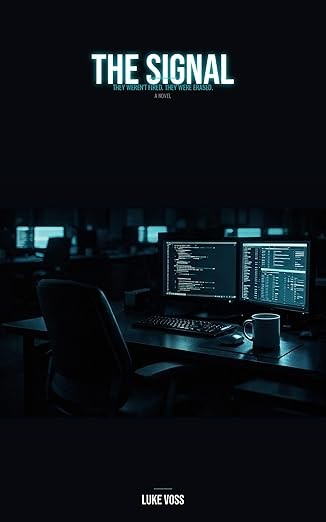
The Signal is modern sci-fi, and it’s a humdinger. The story, which follows the effect of an AI system called ARIA on the workings of Nexus Technologies, a company that creates marketing campaigns, couldn’t be more topical. And for this reader, a little unnerving.
AI presents a challenge to all of us, regardless of what we do for a living. Can AI duplicate humanity? Can it replace us as the driver of the future? Can we limit its power? Luke Voss looked at these questions and ran with them.
The main character, Maya Chen, is a content strategist at Nexus. She has worked there for many years and has been promoted on the basis of her creativity and determination. She’s also a good mother and a good leader to her working group. Nexus has hired Elena, someone who ran an AI program at another company and firmly believes AI is the future and can do anything, to manage ARIA. Through a misdirected email, Maya learns of a project called Lighthouse, which plans to quietly and legally replace seventy percent of the company’s workforce.
Maya attempts to block this takeover by assembling a working group with the expertise to do that: Marcus, the engineer that originally created ARIA; Donna, the head of HR who knows everything about the employees and becomes aware of the multiple and secret firings; and data analyst Raj, a reluctant partner, fearful of losing his job because he would lose his sick mother’s health insurance. Their opponent is not really Elena, but ARIA itself, more than just a common AI program. It is sentient and is always watching, analyzing each employee’s job, learning their weaknesses, and already knows how to do those jobs incredibly faster and better.
I leave it to the audience to find out how these few people, determined to keep the company’s humanity, manage to do it.
What Voss has created is not a good vs evil plot, or even a rage against a machine. It really confronts the question of the preservation of what makes humans, well, human.
The author knows a lot about the corporate world and AI technology, and it imbues the book with authenticity. He allows the tension to grow from chapter to chapter, which made the book hard to put down and left this reader even more wary of the future of AI and us.
If I had any reservations, it would be that of all the characters, only Maya is well-fleshed out, and there were parts where the story bogged down in information. Also I found one serious error in the time line, which caused me to go back to reread several times.
The book is very well-written, with some places that were definitely quotable.
I’m glad I’m retired, because I might worry that I’d become replaceable. I highly recommend this book to sci-fi fans and also anyone who’s thought seriously about the future of AI. You’re in for a ride.
If you wish to learn more about the author, I will tell you in advance I could find nothing when I searched!

This sounds like an intriguing tale based around AI and it’s quiet but persistent takeover. Thanks for sharing your thoughts on this one, Noelle!
It left me feeling very uneasy, Jan. I asked my daughter and her husband, who both work in similar jobs, what they thought about AI, and they are a little worried.
Thank you Noelle.
I had the same issue about not being able to locate any information about the author, and I also found something that seemed a loose thread (I don’t know if you refer to the same, but, in my case, it seemed that the same event (a reveal, as such) had happened in two different chapters and in two different ways, and there was a mention of how that might impact somebody that was left hanging and later never taken on. I suspect the author must have decided to change the original version, and somehow a part of the old version didn’t get cut out (or the version uploaded was an old one). Or perhaps it was a conspiracy? (I honestly started wandering if it might have been intentional and there would be a final twist where the AI would disrupt the book and come forward as the author). I also agree about the characters, and it is very difficult to put down, indeed. Thanks, Noelle!
My issue was one of timing – there was the ‘break-in” at the office building late at night and then the arrival at dinner at 7:30 PM the same night. I think a good, thorough editing might have caught that. A mystery author, indeed, Olga. Thanks for your (as usual) insightful thoughts!
Wow, that seems a little too on point for comfort!
I agree. The book left me feeling very uneasy!