
I haven’t read any historical fiction since Colleen McCullough’s Masters of Rome series, which I thoroughly enjoyed. This novel is an action thriller set toward the end of Nero’s reign, and I liked it as much.
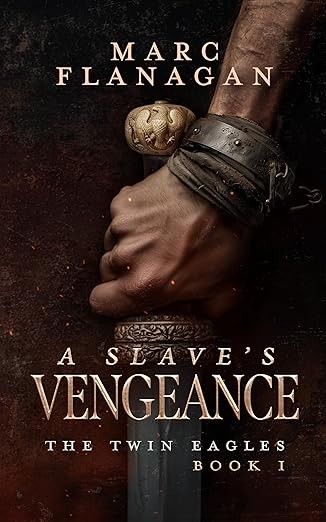
How appropriate that the book should open on the Ides of March, AD 65! Lucius Decimius owes a good sum of money to Julius Lupus, a Gaul who procures slaves for the Emperor’s house. When Lucius can’t pay, he gives Julius his ten year old daughter, Lucilla, in exchange for his own life. When his son, fifteen-year-old Marcus, returns from Ostea with his sister to meet his father, he discovers him with Julius and two of his thugs. He is choked to unconsciousness by Julius and awakes to discover Lucilla gone. When his father tells him what he did, Marcus beats his father to death in a rage and then runs to Rome, to find a place to hide and to find his sister.
Rome is part ash from the Great Fire and part the overwhelmingly costly rebuild of Nero’s complex, which is bleeding the empire dry. Lucilla is sold into slavery to the Domus Aurea, the golden house of the Emperor himself. While looking unsuccessfully for Lucilla, Marcus discovers the only way he can survive is to join a gang of cutthroats in the alleys of Rome. He learns to fight, to kill, spends time in the city’s dungeons, and is eventually sold into slavery himself to work in the household of Senator Valens.
I will leave the reader to discover how Marcus develops in the household as the slave of the Senator’s teenage son, Brutus, who is preparing to be recognized as a man of Rome by donning the toga virilis. Rome at the time is a viper’s nest of conspiracy to eliminate Nero, whose whim dictates life and death and who is becoming more irrational by the day. The tentacles of Roman politics ensnare even the Senator’s house. In the midst of all this and his life as a slave, can Marcus ever discover where Lucilla was taken?
I loved the historical context of the book, well researched, with a glossary at the beginning to explain the Latin terms used. The author has created a colorful picture of Rome, both its filth and its beauty, and uses sounds, scents and color to create the background. The author’s writing style is engaging, smoothly blending historical context into the fictional narrative.
The narrative explores themes of oppression and resilience through the characters of both Marcus and Lucilla. The development of all the main characters is evident, showing both their physical and emotional growth, along with some of Marcus’s hot-headed and dangerous moments.
I found the plot gripping. It maintained my interest through unexpected twists and the realism of the characters, and demonstrated the consequences of slavery and revenge in Nero’s Rome.
I highly recommend this for readers of historical fiction with a lot of action, and I look forward to the next two books in this series!
About the author:

Hailing from York, Marc Flanagan has been a fan of historical fiction since the age of fourteen. His love of Ancient Rome began with Shakespeare’s Julius Caesar in English class. Until his teenage years, he mostly read fantasy authors, but a birthday gift of Simon Scarrow’s Centurion changed everything. These days, audiobooks are Marc’s medium of choice, allowing him to absorb far more stories while balancing a busy schedule. He loves traveling in Italy, and film and television based on Roman times. Marc writes fast-paced, character-driven action thrillers designed to pull you right into the dirt and glory of the ancient world, hoping to infuse theatrical intensity and epic scale into his writing.
You can find the author at
https://www.marcflanagan.co.uk/blog
https://www.facebook.com/marc.flanagan.author

Thanks, Noelle. I liked the sound of this one, but I was a bit worried about starting a new series, as I don’t have a lot of time for reading these days. It sounds as if I should seriously think about it, though. ♥
I think you would like it, Olga. A lot of it is how the characters grow and adapt to their situations and I really enjoyed the creation of Rome in Nero’s time! Thanks for stopping by!
Thank you Noelle.
You’re welcome!
Thanks for sharing your thoughts on this book, Noelle. The cover is also stunning!
It is, isn’t it. I am definitely looking forward to the next book. I think it’s out in September.